
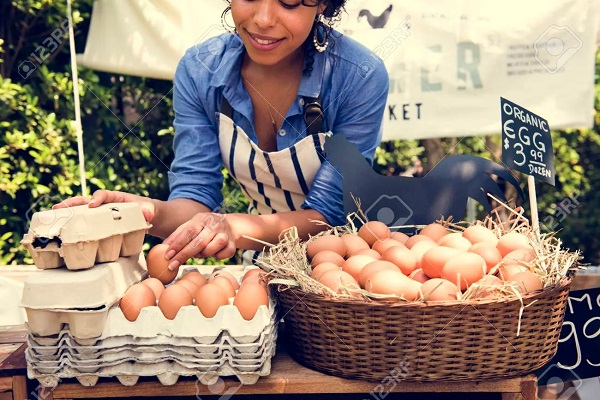
Marketing and Selling Chicken Eggs – Probably no animal product of the farm is produced in a more sanitary or convenient form for marketing than eggs. They are one of nature’s choicest food products. Nevertheless, many farmers experience considerable difficulty in shipping eggs to market that will command the top price.
The principal reason is probably due to the fact that eggs are very perishable when improperly handled and are then very quickly affected by their surroundings. The sale of eggs is also governed by their interior quality, size, color, appearance, the type and condition of container, season of the year, and the like.
All these factors nay be controlled to a large extent by breeding, proper care, and good management. The freshness of an egg has to do with its age and quality: when used for food. The highest standard of quality in an egg is one just laid (“new laid”). It is customary to speak of “new laid” eggs as fresh eggs.

Almost every one has this definition in mind when speaking of fresh eggs; but, inasmuch as the quality of an egg is very quickly affected by unfavorable sur- rounding’s, freshness is more largely a matter of care and handling after the egg is laid rather than age. For example, it is possible seriously to impair the quality of “new laid” eggs in two or three days, while on the other hand the same eggs, under favorable conditions, might remain fairly fresh after several weeks in storage.
This results in several grades Of eggs according to their interior quality regardless of age.
Structure of Eggs
To understand what take place in eggs when they deteriorate in quality and the factors that are considered in the pricing and utilization Of eggs, it is desirable to have Some knowledge of their structure and of the relationship of one part to another. In a normal new-laid egg of good quality, the yolk is nearly spherical and Of a uniform surface color.
On the surface Of the yolk, usually the upper side. when the egg is broken out, there is a small area lighter in color and about % inch in diameter known as the germ spot. It is in this spot that embryo development in a fertile egg begins; consequently the size and appearance Of the germ spot on the yolk, when viewed before the candle, is Of importance in determining the grade.
The yolk material is enclosed in a covering called the vitelline membrane, which holds the yolk in its normal shape. However, as an egg ages, the yolk tends to take up water from the white with a consequent enlargement in size, and the yolk membrane weakens as a result, permitting the yolk to assume a more flattened or spread-out shape when the egg is broken out on a flat surface.” “The white, or albumen, of the egg consists of several parts or layers Of thick and thin white. The yolk is suspended in the white by a twisted, ropelike mass at each end of the egg, known as the chalaza. The yolk floats and turns easily within the white. Lining the shell are two membranes commonly described as the inner shell membrane, which is next to the contents of the egg, and the outer shell membrane, which is next to the shell.
These membranes are close together and normally do not become separated except at the large end where, as the fresh egg cools and as it ages and the water and gas escape from the egg, the two membranes draw apart and the space between them is filled with air.
The Shell is the container for the liquid parts within. When new-laid the egg is coated with a gelatinous covering which tends to seal the pores and gives the shell its bloom. Unless eggs are handled and kept under good conditions in a relatively short time they may reach a Stage at which they are no longer edible. One of the first indications of deterioration is the evaporation of water from the white through the shell, with the consequent enlargement of the air cell. Another is the flattening of the yolk already described.
Marketing and Selling Chicken Eggs
YouTube Channel: Farming South Africa
Facebook Page: Farming Life
Back To Home Page: Farming South Africa
Tags how to market chicken eggs, how to sell chicken eggs, marketing and selling chicken eggs, tips on selling chicken eggs, the best way to sell your eggs, selling backyard chicken eggs
2 thoughts on “Marketing and Selling Chicken Eggs”